Professional Practice Standards in Alberta

I’m excited to share our new article, Alberta’s Professional Practice Standards as a Coherence Framework, recently published in Interchange. In this paper, we explore how Alberta’s Teaching Quality Standard, Leadership Quality Standard, and Superintendent Leadership Quality Standard function as connected and a nested framework designed to support coherence in Alberta’s education system. Drawing on findings from the four-year Optimum Learning for All Students study, we argue that professional standards can do more than simply define role expectations. When intentionally connected, standards can help create shared language, align professional learning and evaluation processes, and strengthen relationships about among teachers, school leaders and system leaders. This work contributes to broader conversations about instructional leadership, systems leadership, policy coherence and professional responsibility in education.

You can read the open-access article here:

Friesen, S. & Brown, B. (2026). Alberta’s professional standards as a coherence framework. Interchangehttps://doi.org/10.1007/s10780-026-09565-6

Other related articles:

Brown, B. & Friesen, S. (2025). Stages of teaching expertise from routine to adaptive: A model for advancing teaching effectiveness. Studies in Educational Evaluation, 87, 1-12. https://doi.org/10.1016/j.stueduc.2025.101530

Friesen, S. & Brown, B.(2025). How adaptive leaders turned crisis into opportunity. Leading & Managing: Journal of the Australian Council for Educational Leaders, 31(2), 19-40. https://journals.flvc.org/leading-and-managing/issue/view/6533

Resources for Research-Practice Partnerships

  • Friesen, S. & Brown, B. (2023). Engaging in educational research-practice partnerships: Guided strategies and applied case studies for scholars in the field. Routledge.

Note: This is a 10-chapter book based on a decade of research projects and design-based professional learning initiatives.

https://www.routledge.com/Engaging-in-Educational-Research-Practice-Partnerships-Guided-Strategies-and-Applied-Case-Studies-for-Scholars-in-the-Field/Friesen-Brown/p/book/9781032135151

Open Access Articles:

  • Brown, B. (2021). Research-practice partnerships in education: Benefits for researchers and practitioners. Alberta Journal of Educational Research, 64(4). 421-441. https://doi.org/10.11575/ajer.v67i4.70073  
  • Brown, B., Friesen, S., Mosher, R., Chu, M-W., & Linton, K. (2021). Adapting to a design-based professional learning intervention. Educational Design Research (EdER), 5(2), 1-24. https://doi.org/10.15460/eder.5.2.1658
  • Friesen, S. & Brown, B. (2021). Advancing knowledge creation in education through tripartite partnerships. Canadian Journal of Learning and Technology, 47(4). https://doi.org/10.21432/cjlt28052
  • Hamilton, S., Braunberger, D., & Brown, B. (2022). Conceptualizing a foundation to lead a school–university research partnership. International Journal of Leadership in Learning, 22(1), 340-363. https://doi.org/10.29173/ijll14
  • Holden, M., McDermott, M., Brown, B. & Friesen, S. (2022). What is it like to do community-engaged research? Lessons learned from university researchers’ perspectives. Journal of Community Engagement and Scholarship, 15(1), 1-19.https://doi.org/10.54656/jces.v15i1.444
  • Pearce, A., Anholt, M., Markides, J., Darlington, M., Brown, B., & Roy, S. (2024). Breaking down silos: Postsecondary leaders collaborating to advance One Health in education. International Journal for Leadership in Learning, 24(1), 103–127. https://doi.org/10.29173/ijll46 

Guides/Working Documents: to guide discussions with K-12 and post-secondary research partners

Knowledge Mobilization Examples

  • Research Brief Example

Brown, B. & Egizii, R. (2019). Research-Practice Partnerships in Alberta: Research Brief. Report prepared for Alberta Education. (6 pages) https://prism.ucalgary.ca/handle/1880/110743

  • Infographic Example: developed for a partnership with the Calgary Police Interpretive Centre.

Thomas, C., White, C., Dewar, A., & Brown, B. (2023). Exploring the impact of YouthLink Calgary’s crime prevention program on youth. (Infographic) https://hdl.handle.net/1880/117310

  • OER Example: developed by practitioners and researchers who were part of an RPP.

Lott, C., Wong, L., Susnjar, M., Brown, B., Linton, L, Delanoy, N., Friesen, S., Koh, K., McInnes, C., Walz, J., *Nogueira, B. & *Chen, D. (2025). Five high-impact assessment practices: A starting guide for dialogue about assessment. Calgary: University of Calgary. (38 pages) https://hdl.handle.net/1880/122221

Teacher Leadership

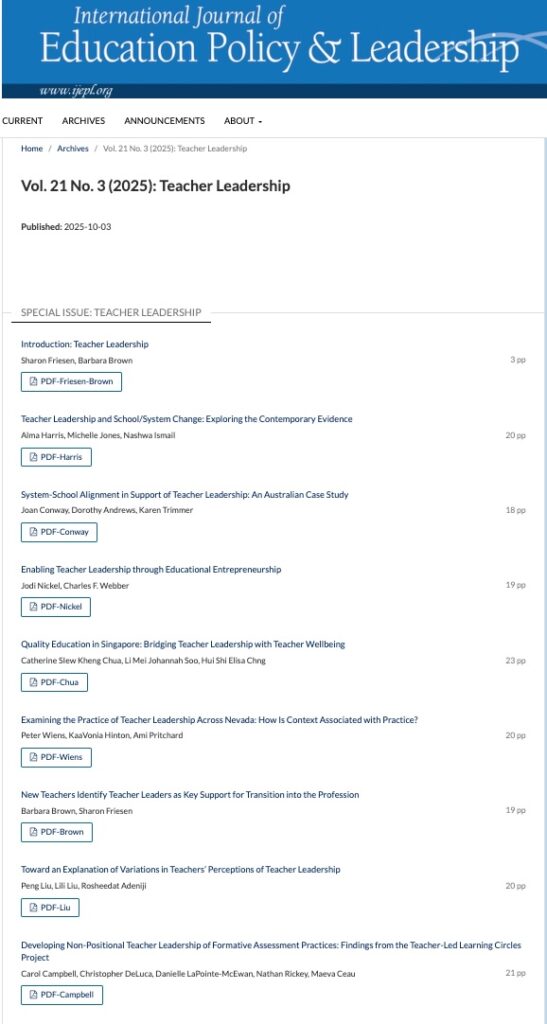
I’m excited to share a new special issue on Teacher Leadership in the International Journal of Education Policy & Leadership, which I had the privilege of co-editing with Dr. Sharon Friesen. This collection brings together eight articles that explore how teacher leaders influence school and system improvement across diverse educational contexts.

Authors highlight teacher leaders as influencers, and professionals who drive meaningful change, strengthening teaching, learning, and collaboration within their schools and beyond.

This special issue offers a rich view of how teacher leadership is involving in different global contexts and how teachers enact leadership in ways that shape professional learning cultures and educational innovation.

Read the full issue here – https://journals.sfu.ca/ijepl/index.php/ijepl/issue/view/255

#TeacherLeadership #EducationalChange #ProfessionalLearning #SchoolImprovement #EducationalLeadership #Research

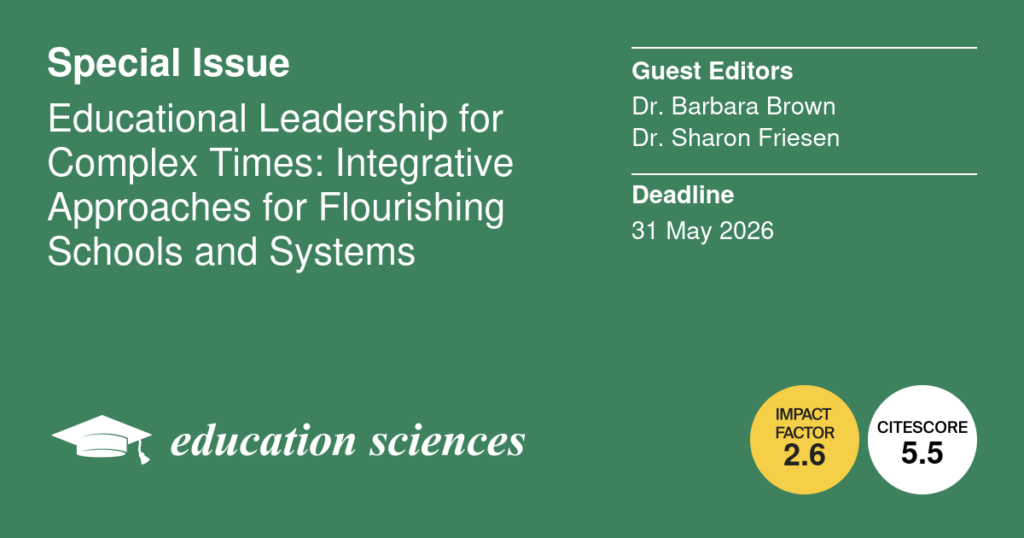
Special Issue Invitation – Educational Leadership

Educational Leadership for Complex Times: Integrative Approaches for Flourishing Schools and Systems

You are invited to submit an article for a special issue that will be published in Educational Sciences, a top-tier academic journal. I’m serving as a guest editor for this special issue with Dr. Sharon Friesen.

More information about the special issue can be found here – https://www.mdpi.com/journal/education/special_issues/TN1EIB8FDA

Manuscripts can be submitted through the journal platform until the deadline – Sept. 30, 2026 (Note: deadline extended to end of September!)

Mobile Device Restrictions in K-12 Schools – will it work?

In recent years, the debate over mobile device restrictions in K-12 schools has intensified. With the rise of smartphones and social media applications, many schools have implemented policies to limit or ban access to these technologies during instructional time. In this blog post, I briefly explore the rationale behind these restrictions, examine some current research findings, and argue for a balanced approach.

Some of the Harms Driving Mobile Device Restrictions

The increasing presence of smartphones and social media in school has been linked to adverse outcomes for students. Research indicates that excessive screen time is associated with a decline in well-being (Pagliaccio et al., 2024). The use of mobile devices in schools has been connected to inappropriate behaviors, such as cheating, cyberbullying, and sexting, which can affect students’ mental health and safety (Dickson et al., 2018). Studies have also found that smartphone addiction can yield negative learning outcomes (Sunday et al., 2021). Concerns about the harms of mobile devices and social media use have led to a widespread call for restrictions on mobile device usage in educational settings.

A Few Research Insights

More research is needed as the effectiveness of restrictions is not well understood and experiences can vary dependent on the context (OECD, 2023; Stoilova et al., 2021). In studies that have explored how mobile devices are used, there are reports that students from K-12 can make effective use of technologies for learning in meaningful and responsible ways. For example, K-grade 4 teachers reported that handheld devices were used to engage young learners in activities such as creating multimedia artifacts (Jacobsen et al., 2021). In a study with 9-to-11-year-olds, students used social media for learning and reported activities, such as searching online for information, using videos for learning, taking photos of assignments, accessing digital texts, creating digital content and communicating electronically with their peers and teachers (Sanbrooks & Brown, 2021). In a study with upper secondary students in Sweden, the students noted that a mobile phone is a tool that facilitates their schoolwork (Ott et al., 2018). Students in high schools report using cell phones for time management, accessing information, resources, responding to digital polls created by their teachers, accessing timely feedback, collaborating with others, and accessing outside experts, to name a few.

Despite the uses for facilitating schoolwork, digital technologies are also reported to be distractions in the classroom. For example, the PISA questionnaire administered to 15-year-olds every three years through the Organization for Economic Co-operation and Development found that one in three students becomes distracted while using digital devices in mathematics lessons and students become distracted by their peers using digital devices (OECD, 2023). However, the same study also noted that “moderate use of digital devices in school is related to higher performance; but the relationship differs greatly according to the purpose of use” (p. 231). Read more here about the PISA results – https://www.oecd.org/en/publications/pisa-2022-results-volume-i_53f23881-en.html

The Derek Bok Center for Teaching and Learning at Harvard University describes how college students use devices and engage with media. At the college level, students can also become distracted, and they recommend instructors intentionally provide a variety of pedagogical activities and “by keeping your students engaged, thinking, and doing activities during class, they are less likely to be tempted by digital distractions.” They also highlight the importance of accessibility to assistive technologies and advocate for inclusive practices: “allowing all students access to a device in class avoids singling out students who have important reasons for using one.” Read more here – https://bokcenter.harvard.edu/technology-and-student-distraction

The Need for Balanced Approaches and Investment in Digital Literacy Programs

While restricting mobile device use in schools may seem like a straightforward solution, it is not without challenges. Implementing and enforcing these policies can place additional demands on teachers, potentially disrupting teaching and learning processes. Moreover, simply removing access to technology may not necessarily lead to improved engagement and achievement and will limit inclusion in schools. The debate over mobile device restrictions in K-12 schools highlights the complex relationship between technology and education. While there are valid concerns about the harms associated with excessive mobile device use, it is crucial to adopt balanced approaches that address these issues without hindering students’ access to technology and digital skill development. By investing in digital literacy programs and fostering responsible technology use, schools can create equitable environments where students are situated as partners in learning and can thrive academically and socially, preparing them for a digital future and using the tools of their day.

Dickson, K., Richardson, M., Kwan, I., MacDowall, W., Burchett, H., Stansfield, C., Brunton, G., Sutcliffe, K., & Thomas, J. (2018). Screen-based activities and children and young people’s mental health: A systematic map of reviews. EPPI-Centre, Social Science Research Unit, UCL Institute of Education, University College London. https://eppi.ioe.ac.uk/cms/Default.aspx?tabid=3748

Jacobsen, M., Friesen, S., & Brown, B. (2021). Teachers’ Professional Learning Focused on Designs for Early Learners and Technology.  In Information Resources Management Association (Eds.) Research Anthology on Facilitating New Educational Practices Through Communities of Learning, pp. 456-477. IGI Global. https://doi.org/10.4018/978-1-7998-7294-8.ch024 

OECD (2023), PISA 2022 Results (Volume I): The State of Learning and Equity in Education, PISA, OECD Publishing, Paris, https://doi.org/10.1787/53f23881-en

Ott, T., Magnusson, A. G., Weilenmann, A., & Hård af Segerstad, Y. (2018). “It must not disturb, it’s as simple as that”: Students’ voices on mobile phones in the infrastructure for learning in Swedish upper secondary school. Education and Information Technologies, 23(1), 517–536. https://doi.org/10.1007/s10639-017-9615-0

Pagliaccio, D., Tran, K. T., Visoki, E., DiDomenico, G. E., Auerbach, R. P., & Barzilay, R. (2024). Probing the digital exposome: Associations of social media use patterns with youth mental health. NPP—Digital Psychiatry and Neuroscience, 2(1), 1–10. https://doi.org/10.1038/s44277-024-00006-9

Sanbrooks, J. & Brown, B. (2021). Social media use among 9-to-11-year-old children and influences on leadership practices in schools. In M. Griffin & C. Zinskie (Eds.) Social media: Influences on education, Information Age Publishing, Inc. https://www.infoagepub.com/products/Social-Media

Stoilova, M., Edwards, C., Kostyrka-Allchorne, K., Livingstone, S., & Sonuga-Barke, E. (2021, December). The impact of digital experiences on adolescents with mental health vulnerabilities: A multimethod pilot study [Monograph]. London School of Economics and Political Science. https://www.lse.ac.uk/media-and-communications/research/research-projects/Adolescent-mental-health-and-development-in-the-digital-world

Sunday, O. J., Adesope, O. O., & Maarhuis, P. L. (2021). The effects of smartphone addiction on learning: A meta-analysis. Computers in Human Behavior Reports, 4, 100114. https://doi.org/10.1016/j.chbr.2021.100114


Flipped Learning Grades 6 to 9

This article is about a flipped learning approach involving four teachers and 65 students in grades 6, 7, and 9 science, math, and social studies in a Canadian school. We used the TPACK framework to inform the instructional design of the activities through professional learning sessions with the teachers. The results were based on teachers’ reflections and a student survey. Teachers found they had more time during class to support students’ learning and that prelearning video activities complemented the in-class learning and supported students with English language learning. The article is open access and can be accessed using the following link:

Delanoy, N., El-Hacha, J., Miller, M., & Brown, B. (2024). Implementing a flipped learning approach with TPACK in grades 6 to 9. Canadian Journal of Learning and Technology, 50(1), 1-20. https://doi.org/10.21432/cjlt28506

Other articles related to flipped learning:

Brown, B., Delanoy, N., & Webster, M. (2022, May 18). Flipped learning in grade 7 and 9 mathematics [Proceedings]. Open Technology in Education, Society, and Scholarship Association (OTESSA) Conference Proceedings, 2(1), 1-8. https://doi.org/10.18357/otessac.2022.2.1.23

Mazur, A., Brown, B., & Jacobsen, M. (2015). Learning designs using flipped classroom instruction. Canadian Journal of Learning Technology, 41(2), 1-26. https://www.cjlt.ca/index.php/cjlt/article/view/26977

Knowledge Brokering

Friesen, S. & Brown, B. (2024). Knowledge brokering pivotal in professional learning: Quality use of research contributes to teacher-leaders’ confidence. Frontiers in Education, 9, 1-13. https://doi.org/10.3389/feduc.2024.1430357

What is knowledge brokering? In simple terms, knowledge brokering can be used to describe a process for connecting research and practice that involves a relationship between researchers and practitioners. This article discusses how knowledge brokering within educational networks can play a role in supporting educators with research. We describe a study with a group of Canadian teachers who engaged in a design-based professional learning series and examine participant’s reflections about their use of research in their practice. We used Rickinson et al.’s (2022) Quality Use of Research Evidence framework as a lens for analysis. Meaningful integration of research in professional learning contributed to teachers’ confidence in their individual practice, as well as their confidence in collaboration with colleagues in their schools, and confidence in having professional conversations with colleagues from other schools, and confidence in keeping abreast of the research informing system level decisions. Knowledge brokering is an important function of professional learning networks and design-based professional learning initiatives. The article is available through open access – https://doi.org/10.3389/feduc.2024.1430357

Reference:

Rickinson, M., Cirkony, C., Walsh, L., Gleeson, J., Cutler, B., & Salisbury, M. (2022). A framework for understanding the quality of evidence use in education. Educational Research, 64(2), 133-158. https://doi.org/10.1080/00131881.2022.2054452

Tips for Writing Article from your Dissertation

I have been receiving questions about recommendations for how to get started when writing an article from your dissertation or a research project. Here’s a few tips to get started:

I highly recommend the book, “Writing Your Journal Article in Twelve Weeks: A Guide to Academic Publishing Success” by Wendy Laura Belcher. This is a book I used when teaching graduate courses focused on writing educational research courses and continue to recommend to colleagues. The chapters are set-up to walk you through all the steps and can help structure and guide you through the writing process.

I also recommend deciding where you would like to publish. Select a journal in the field with scope and aims that align with your topic. Read current articles and get accustomed to the style and structure commonly used in the journal. Look at the submission requirements (length, style, etc.) to find a good fit for your work. A reminder to check with your supervisor for more advice as this is also dependent on the type of dissertation (e.g., manuscript based).

Another suggestion is to review how another author wrote an article from their dissertation. I often share an example from one of my research collaborators.

Example: Dr. Christy Thomas wrote about one of the findings and expanded on this from the dissertation in the following article:

Article in International Journal for Leadership in Learning (Thomas, 2022)

https://leadershiplearning.ca/index.php/ijll/article/view/5/55

Dissertation: Exploring the impact of professional development partnerships on teaching and learning (Thomas, 2016)

https://prism.ucalgary.ca/server/api/core/bitstreams/70ed8cb2-fbe7-42af-87a0-dc804b8d5341/content

Here’s one more example showing how a conceptual framework was used in my doctoral study:

Brown, B., & Jacobsen, M. (2016). Principals’ technology leadership: How a conceptual framework shaped a mixed methods study. Journal of School Leadership, 26(5), 811-836. https://doi.org/10.1177/105268461602600504

Dissertation (Brown, 2013): How Principals Cultivate Technology Integration and Use Professional Learning Networks https://prism.ucalgary.ca/items/ec61fbec-1617-4341-ab6a-20d4a198bb21

I hope these tips are helpful to get started with sharing your research! This is not intended to be an exhaustive list of tips and may not apply to all types of research projects. Be sure to connect with your supervisor for more advice.

Scholarship of Teaching and Learning

I had the opportunity to present research at the International Society for the Scholarship of Teaching and Learning Conference (ISSOTL23) – https://issotl.com/issotl23/ conference at Utrecht University, which was an exhilarating experience. The research I shared comes from a project funded by a SSHRC Insight Development Grant, which explores online pedagogies to foster social connectedness and professional collaboration (Presentation Slides & Publication List). As the principal investigator, working alongside my collaborator Dr. Christy Thomas, and with the support of two doctoral research assistants, Amber Hartwell and Bruna Nogueira, we delved into how teaching and learning experiences can cultivate online professional collaboration skills.

SoTL, or the Scholarship of Teaching and Learning, is a field I’m deeply passionate about. It’s an interdisciplinary venture that scrutinizes post-secondary teaching and learning, aiming to improve educational practices and outcomes. This scholarship is crucial because it underpins the quality of teaching and learning, offering insights that can transform educational experiences.

More about the International Society for the Scholarship of Teaching and Learning (ISSOTL) and future conferences- https://issotl.com/

Related article from December 4, 2023:

4 letters everyone should know: SoTL. Interview with Gillian Edwards, Taylor Institute for Teaching and Learning, University of Calgary. https://taylorinstitute.ucalgary.ca/news/4-letters-everyone-should-know-sotl